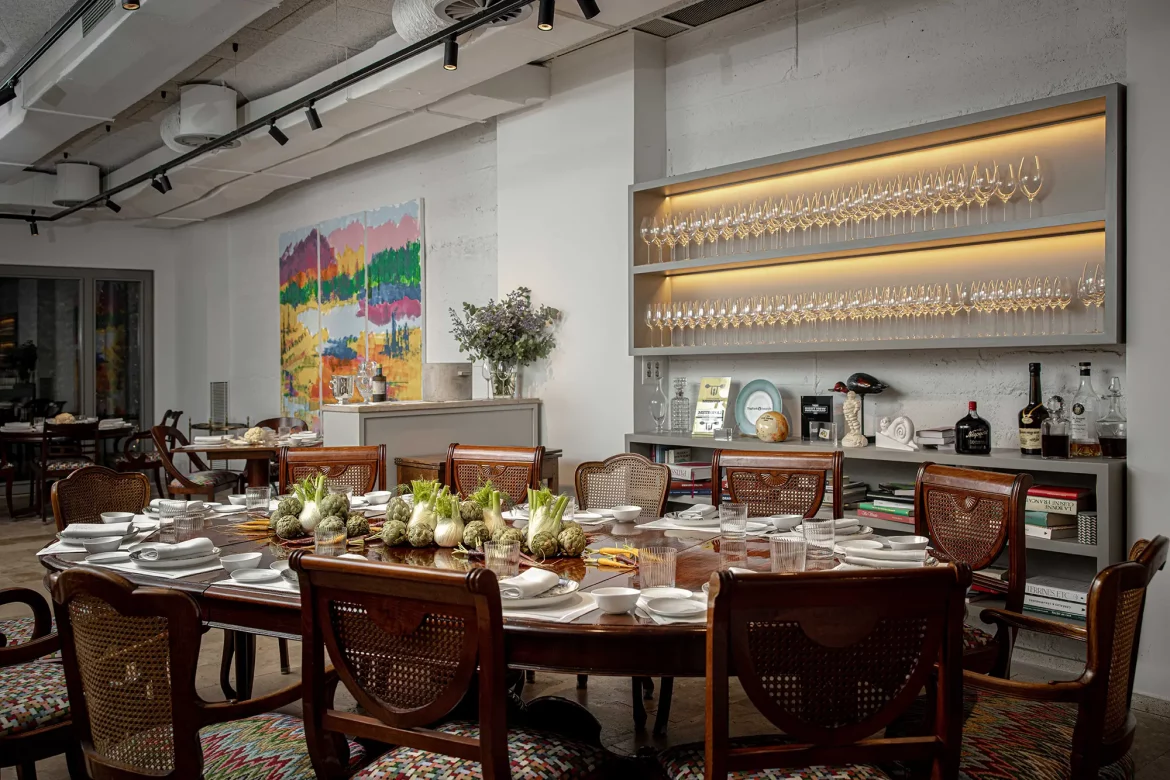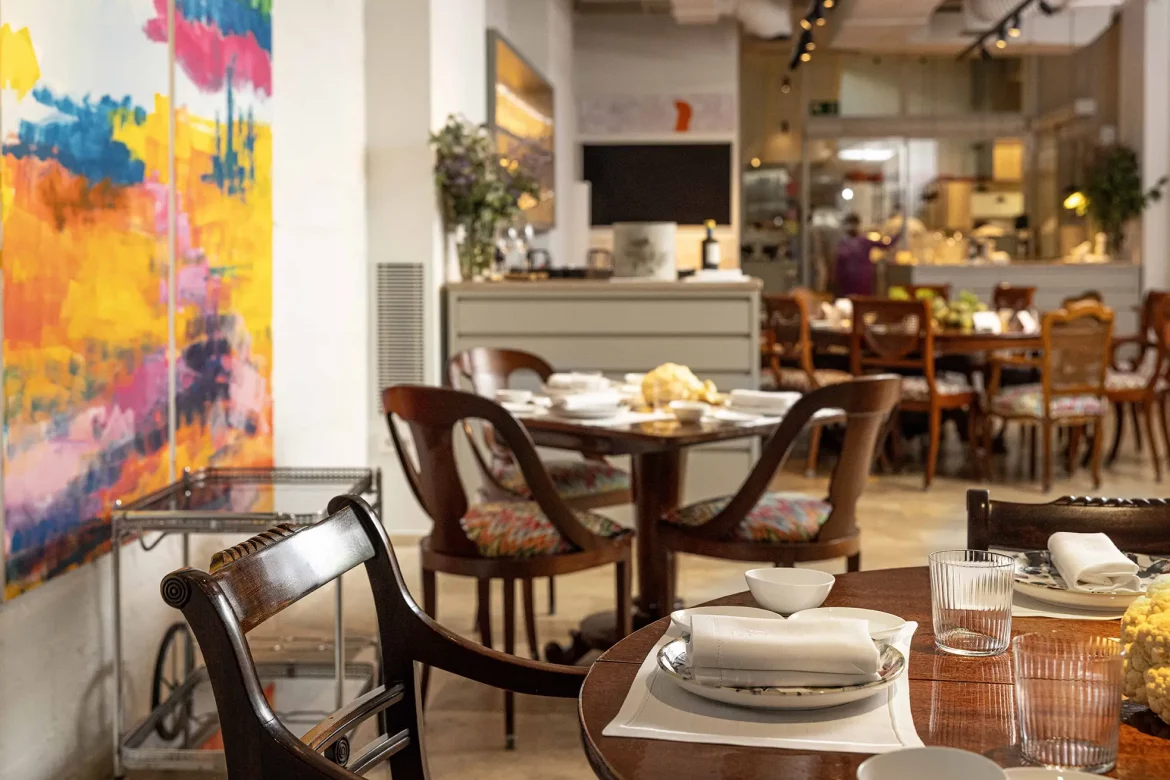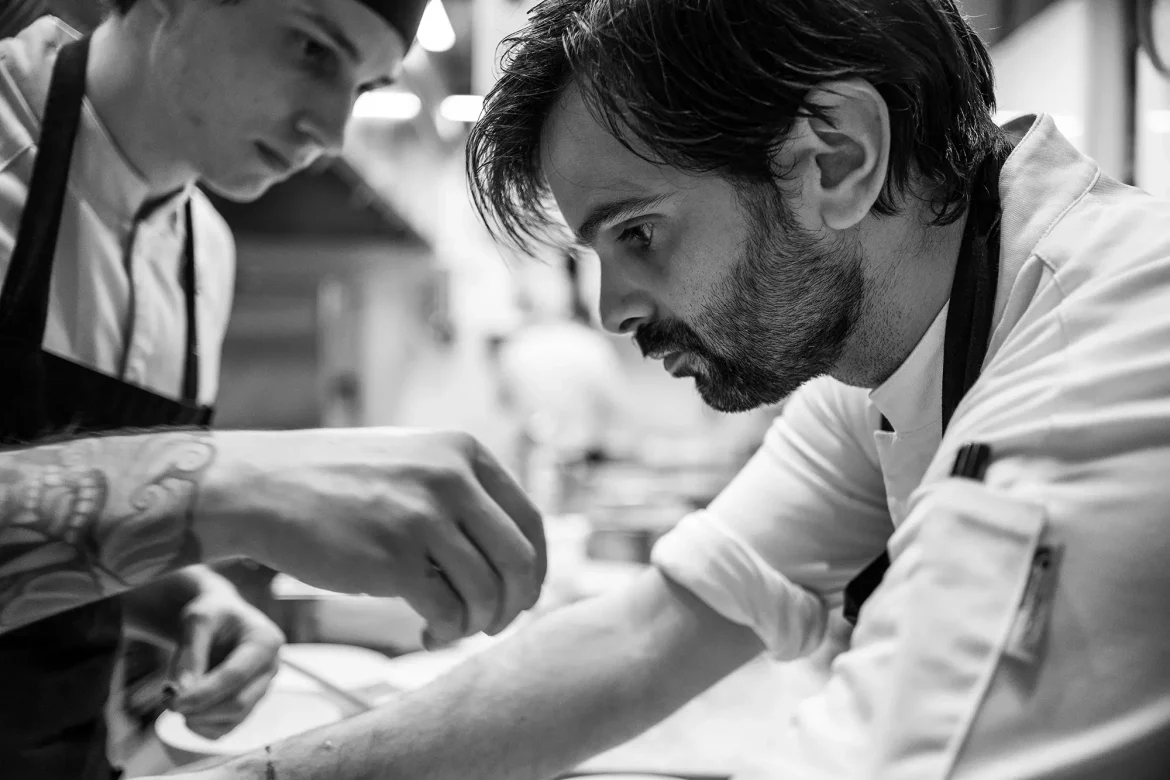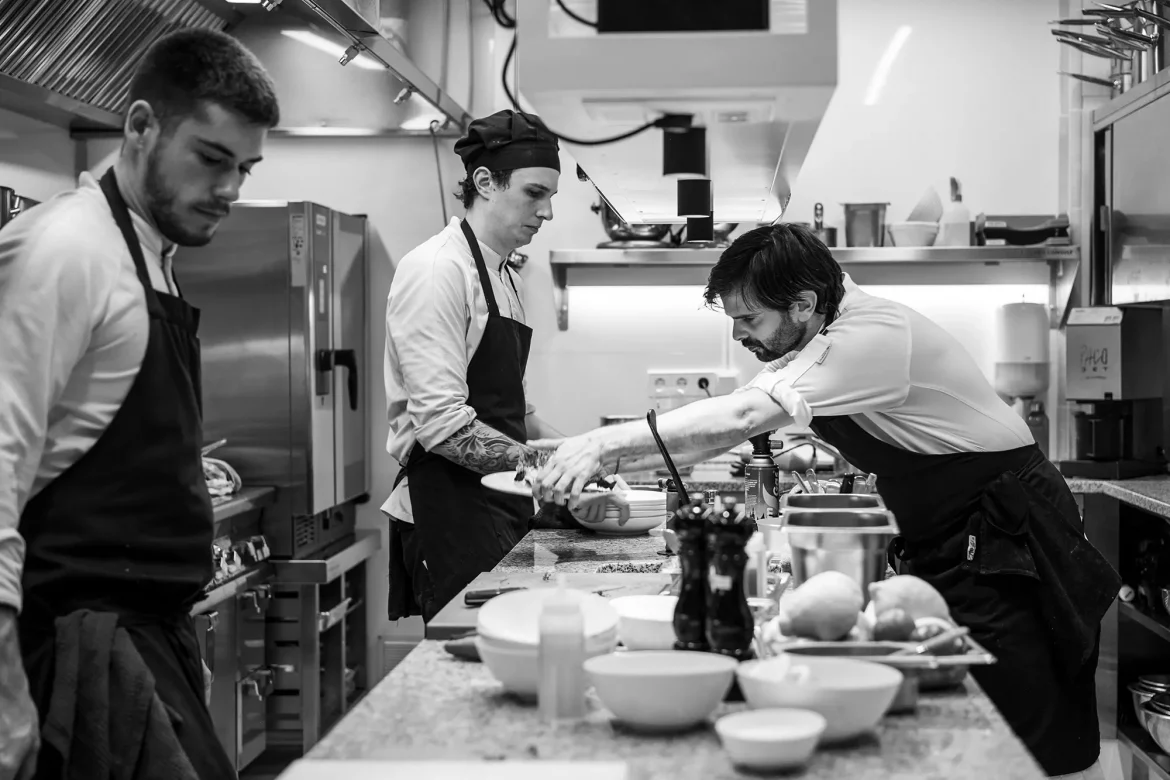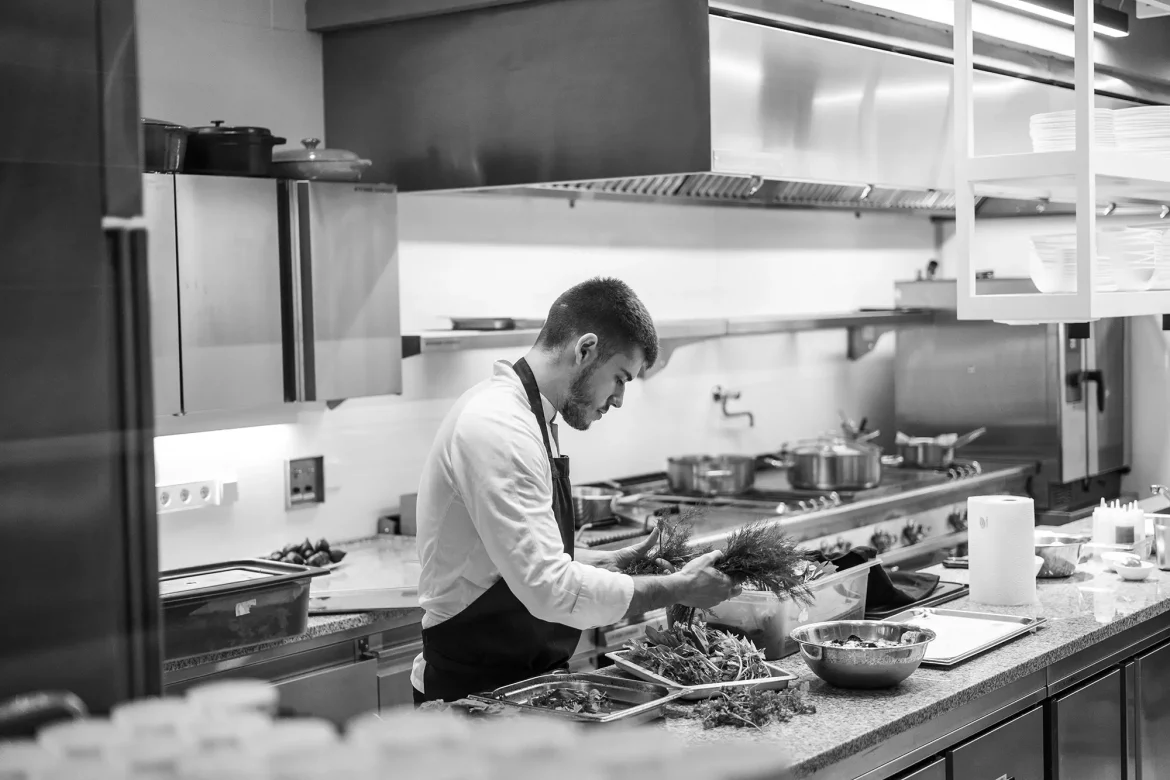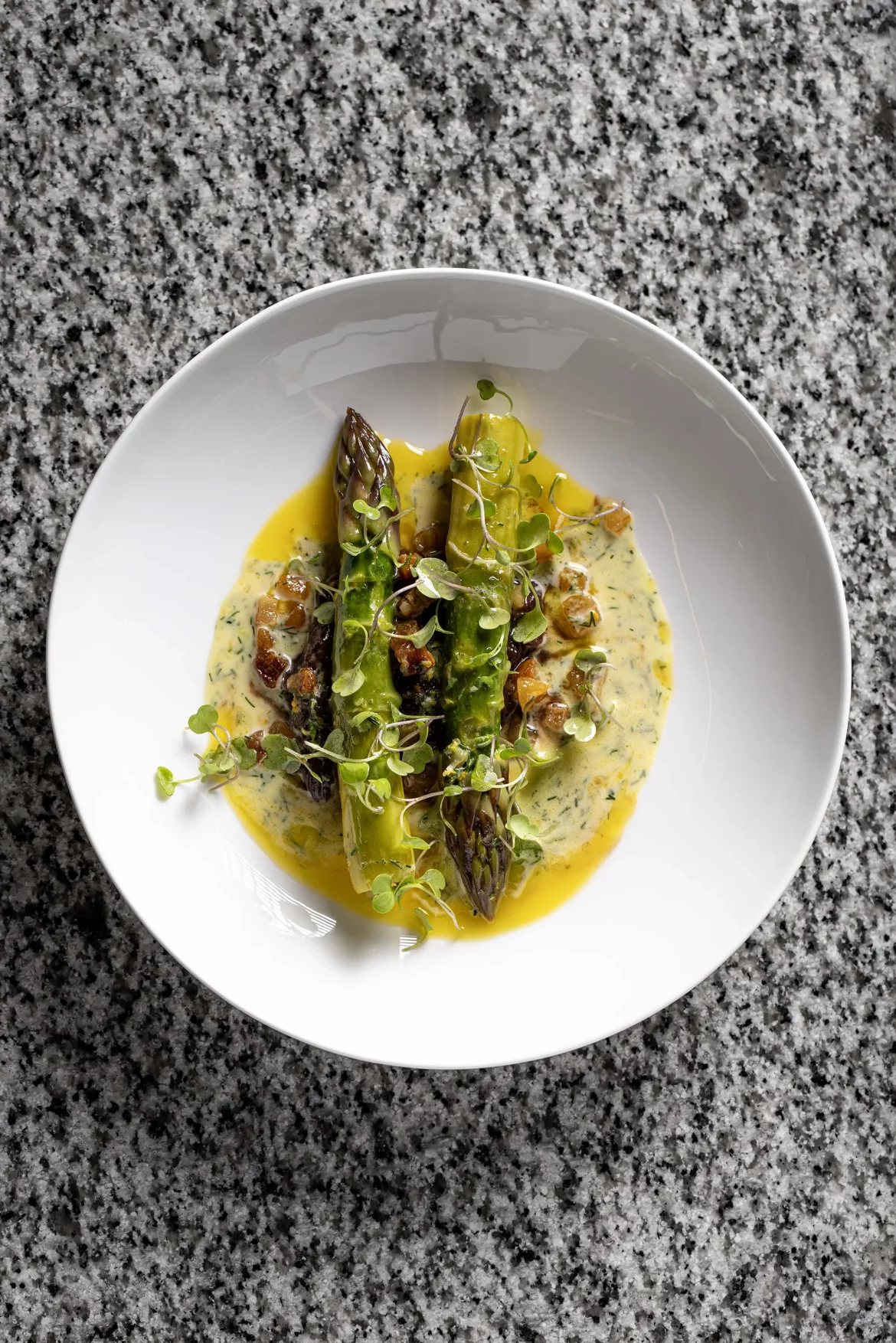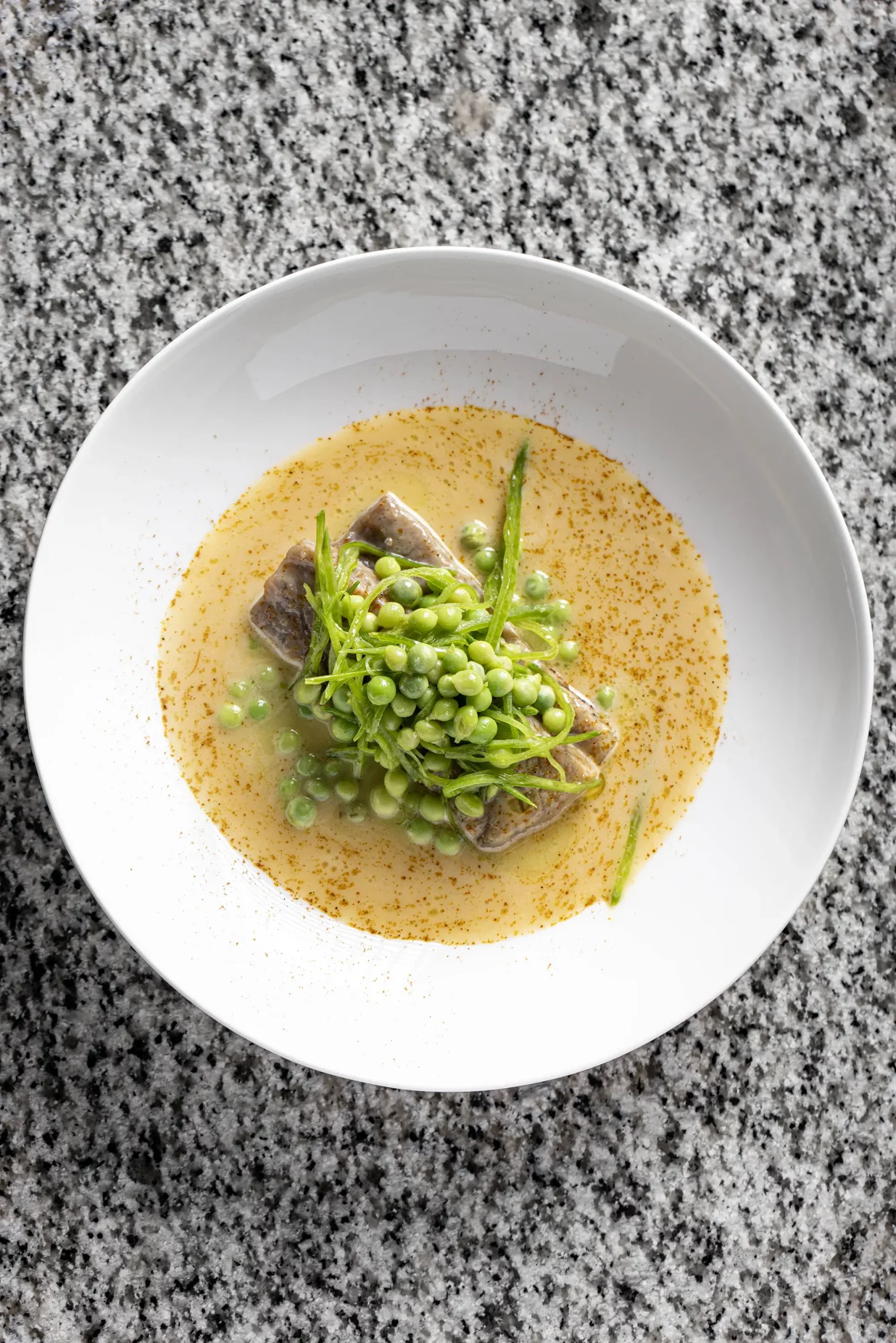



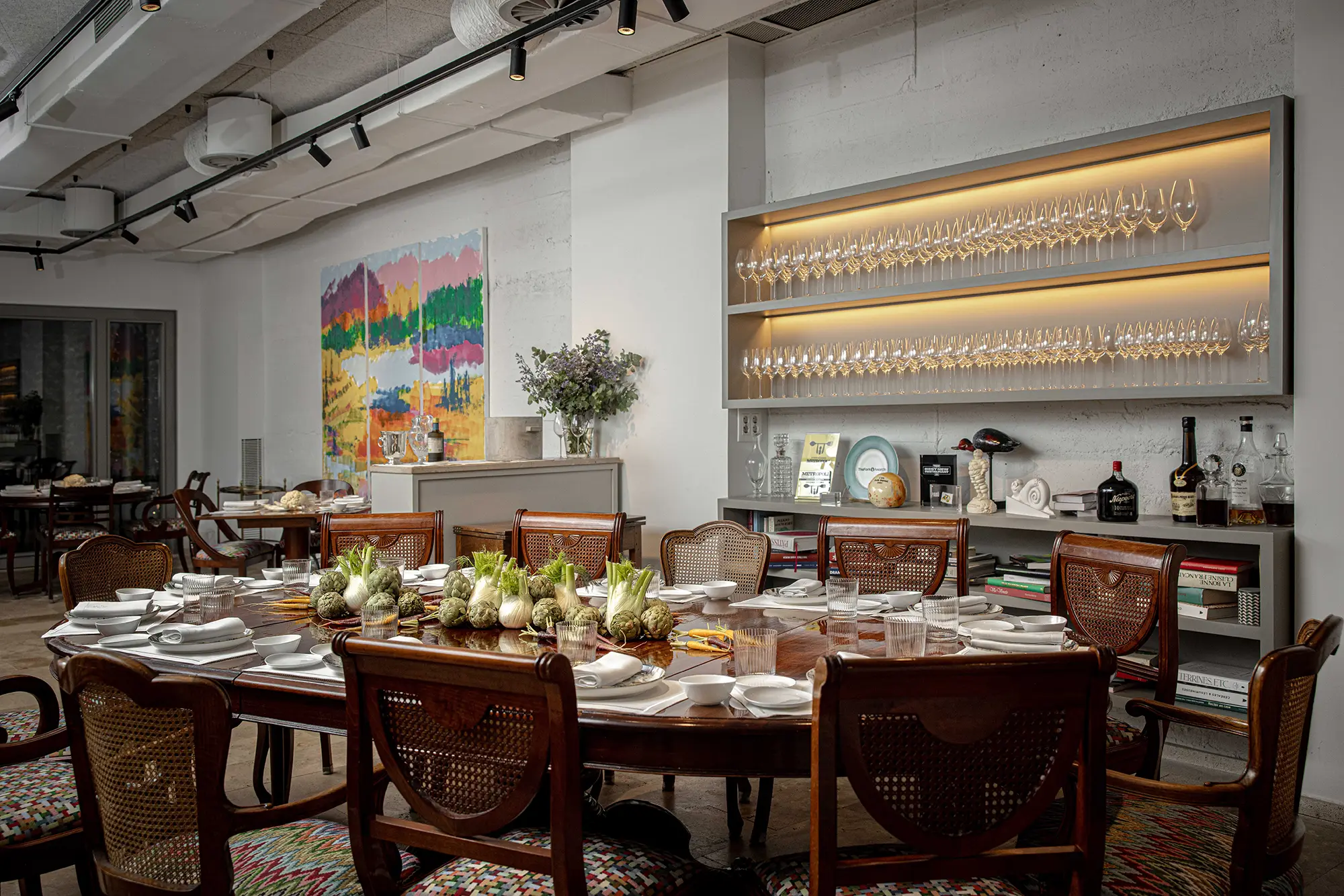
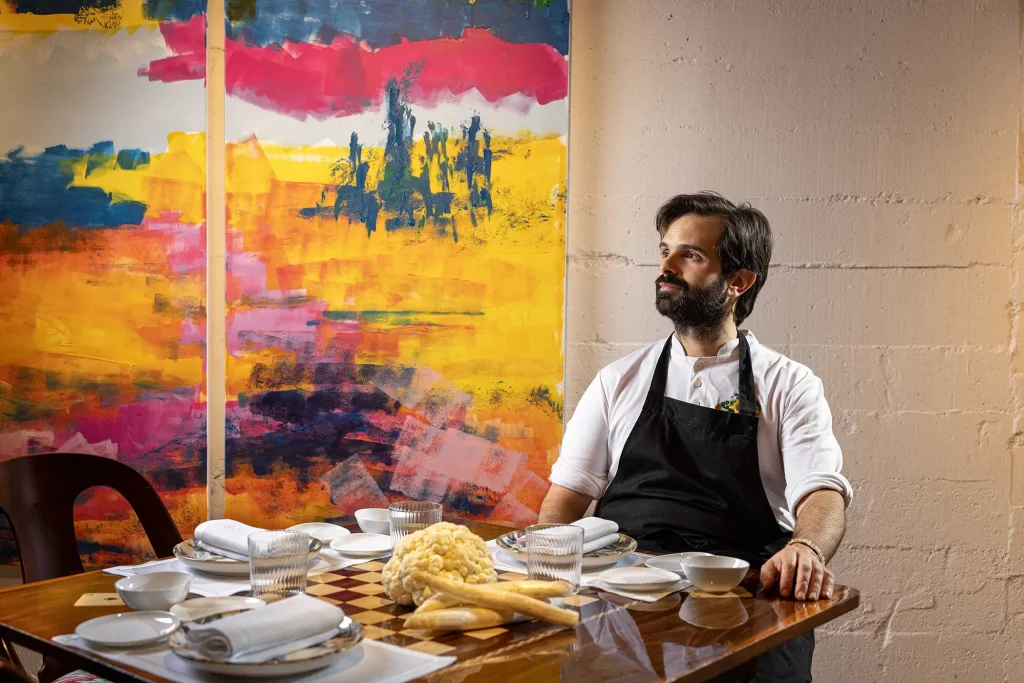
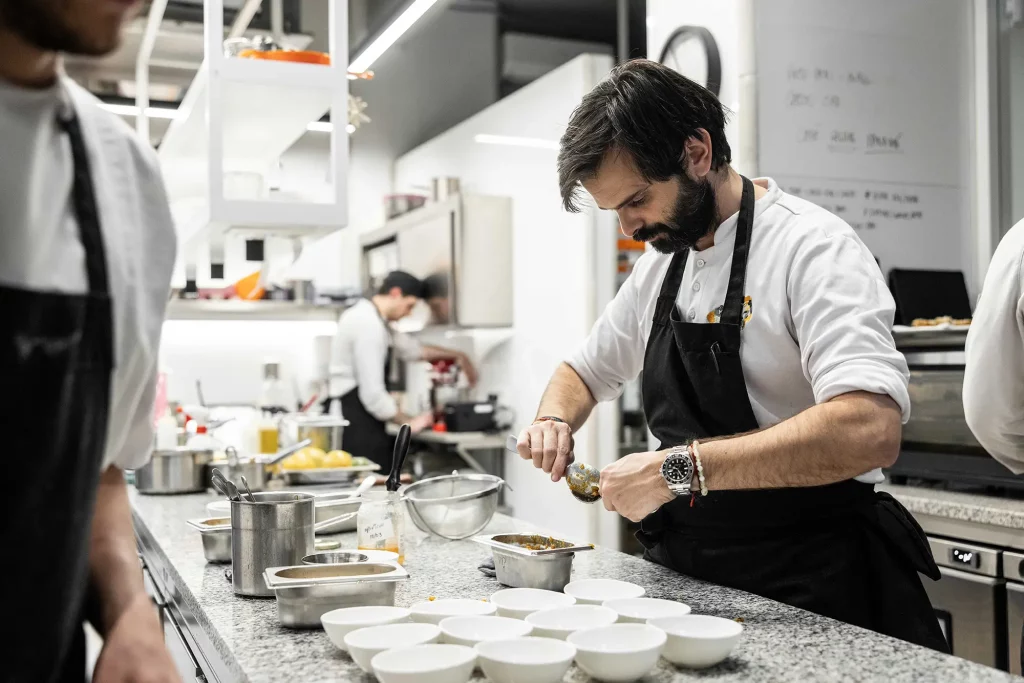
Some chefs send résumés and wait. Coco Montes booked a table at L’Arpège, dined as a guest, and when Alain Passard came out to greet the room, he looked him in the eye and asked for a chance. He got one. That is how he has entered every kitchen that shaped his career — Eleven Madison Park, Azurmendi, Zalacaín — with the conviction that opportunities are not requested in writing but face to face, and that talent is proven by cooking, not explaining. Two years later, in a luminous basement on Calle Panamá with thirty covers and a Michelin star earned in barely a year, that nerve has become a restaurant.
Pabú takes its name from the family nicknames of the chef’s parents — Pate and Bubú — and what in another house would be sentimental decoration is here a founding statement. His mother, Rita González, runs the dining room, painted the art on the walls, designed the uniforms with embroidered vegetables on the shoulder, and orchestrates tableware that shifts character with every course. The menu is printed each morning. Coco calls it microseason cooking — not seasons but weeks — and on the cover, a line worth taking literally: “Sauces are the skeleton of our cooking; enjoy them slowly.”
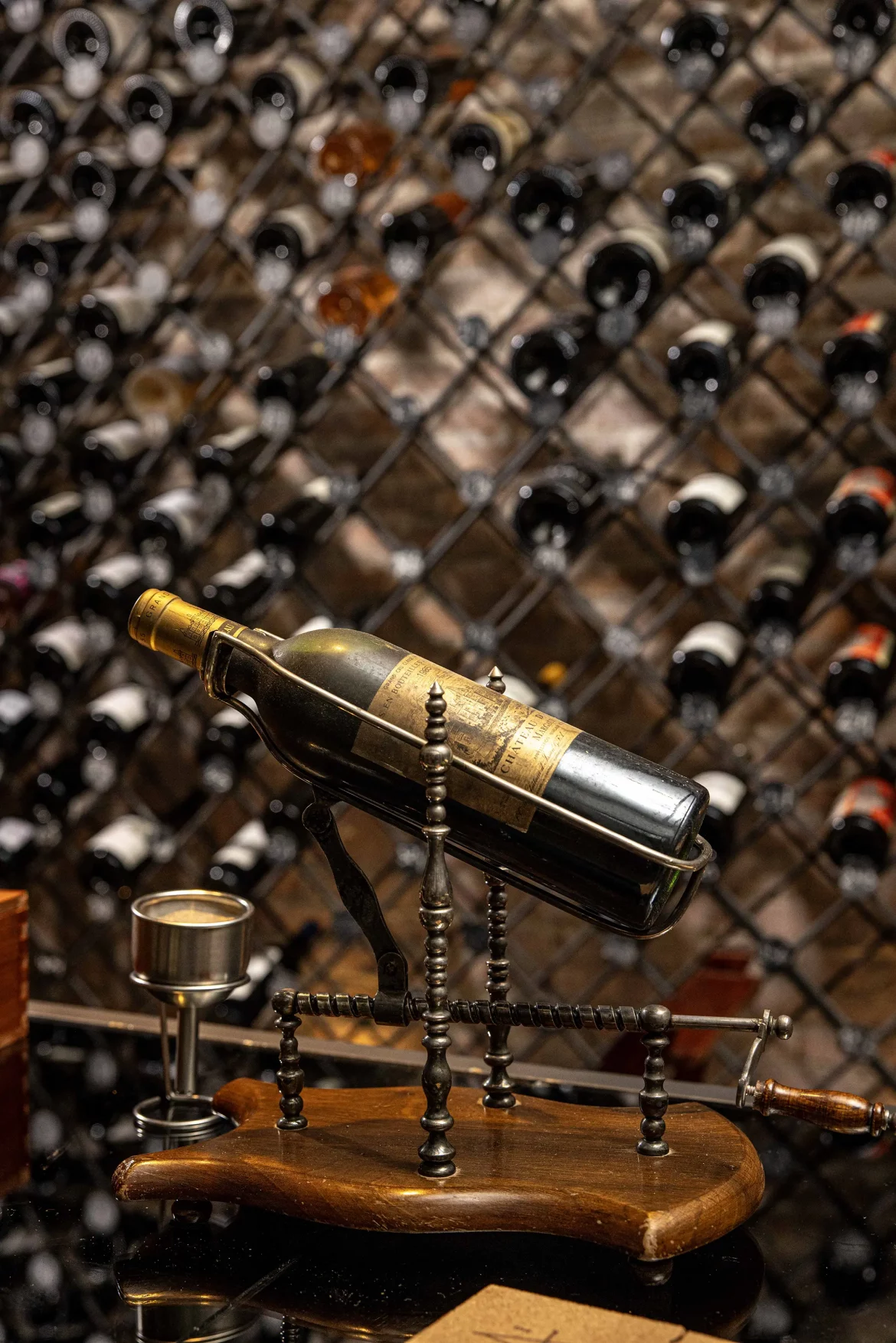
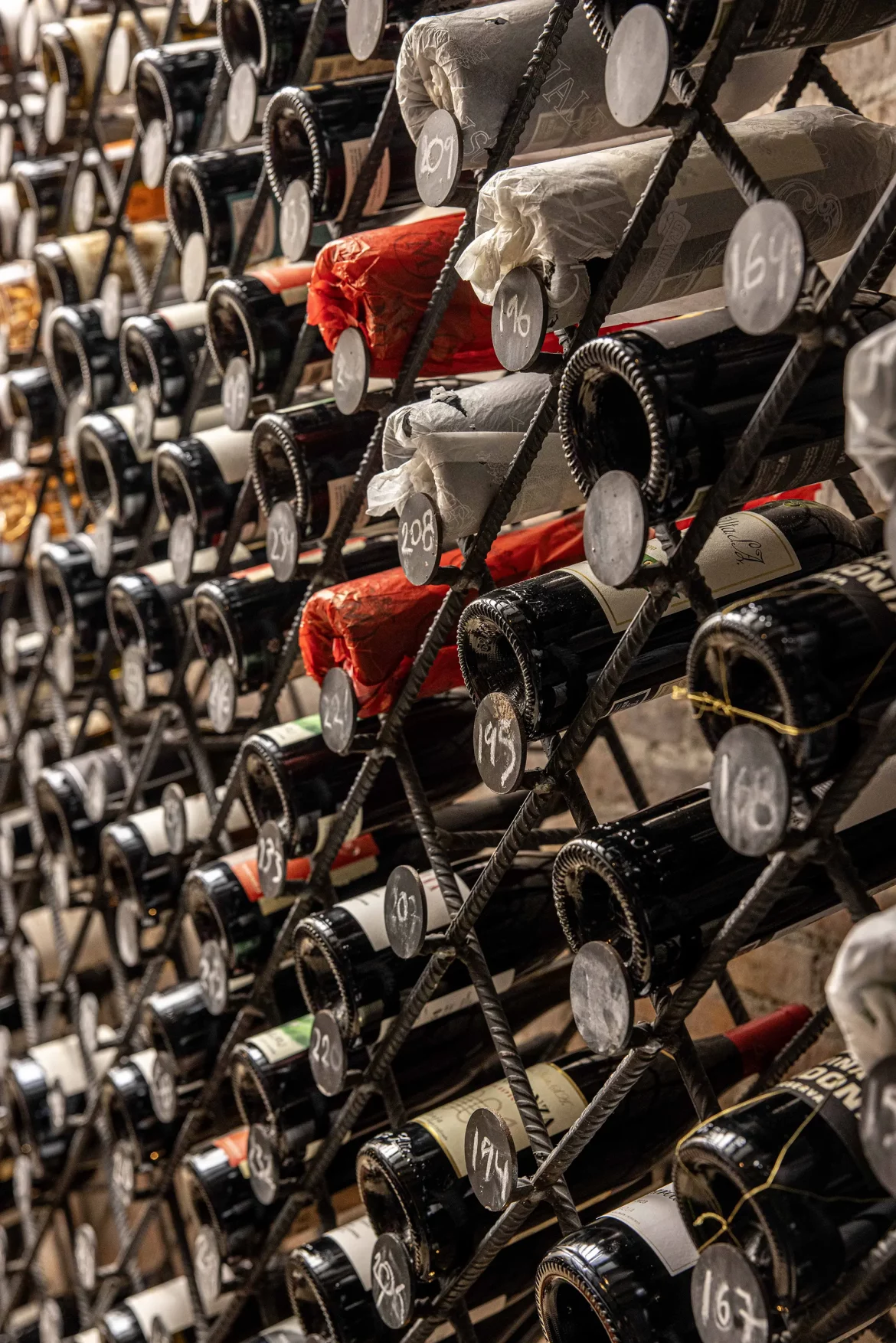
Patricia García, the sommelier, uncorks a Stroebel Triptyque Brut Nature — grower champagne, three vintages, three varietals, three terroirs — and with that first pour declares that Pabú’s cellar thinks for itself. We gave her carte blanche with the pairing and what followed was an improvised conversation between glass and stove. Nearly the entire list — over 250 references — can be served by the glass, something extraordinarily rare in Madrid’s fine dining.
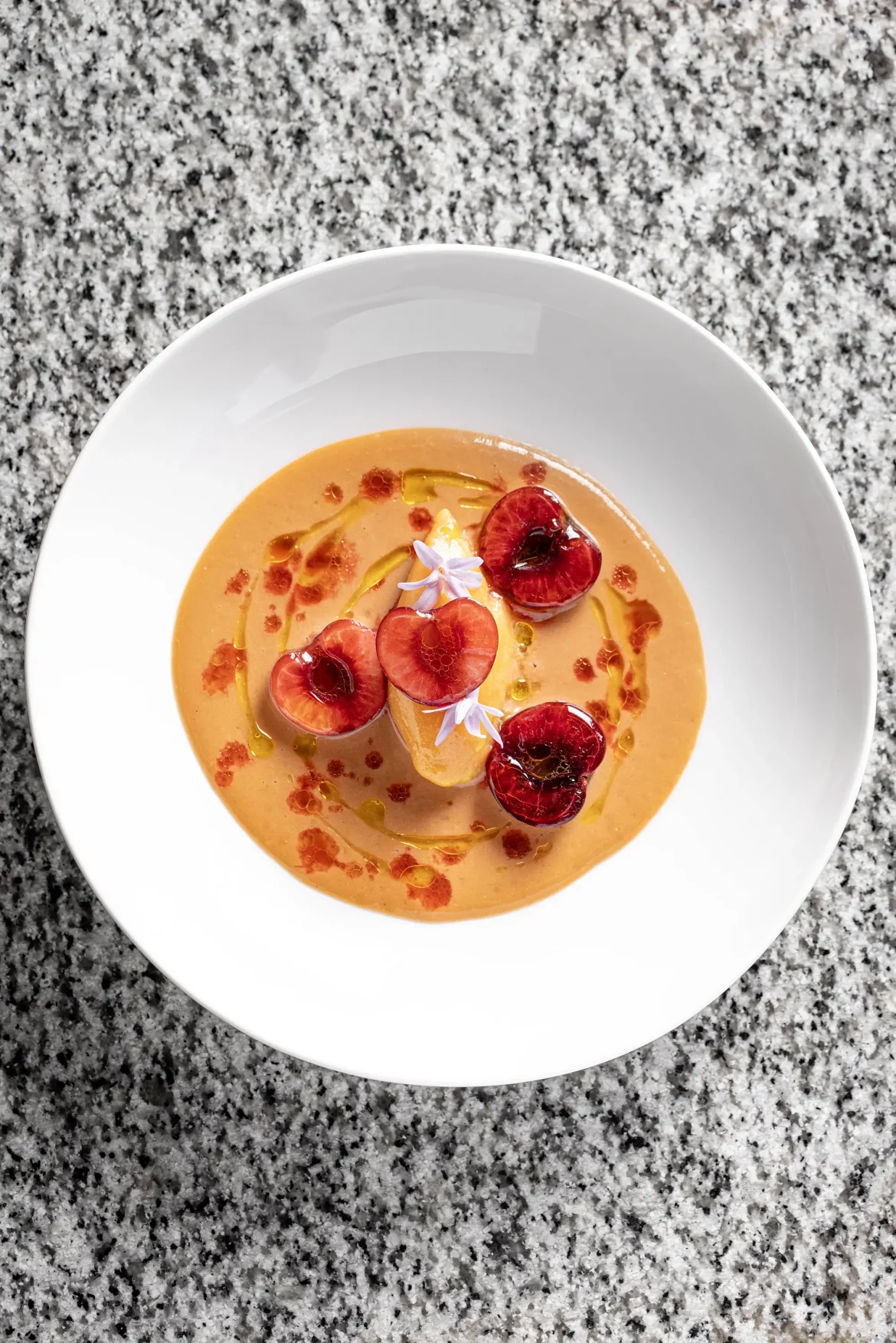
Every course arrives in two parts: a piece on the left to eat by hand and a plated dish in the centre for cutlery, plus bread when the moment calls for it. Five different breads throughout the menu, all sourdough, all house-made, each with a distinct narrative function: the first foreshadows the next course aromatically, the second closes one dish and opens another, the third accompanies, the fourth cleanses the palate, the fifth speaks the Alsatian dialect of the cheeses it escorts. Artisan bakery within an artisan restaurant.
The amuse-bouche arrives in a vintage crystal coupe: raw apple, 36-month Parmigiano, and hidden beneath it all, a silky emulsion of Marcona almond and horseradish that anchors the bite without revealing itself. First invisible sauce of the menu. A reinterpreted céleri-rémoulade that maps three countries in one mouthful: Marcona for Spain, raifort for France, Parmigiano for Italy. That geographic triangle will recur in every course.
The Sanlúcar broad beans with tarragon are the first moment the table falls silent. They arrive over a coconut vinaigrette with tarragon cream woven through the heart of the dish — an anise note, voluptuous, that pulses between bites. I held my spoon suspended trying to separate the flavours and could not: they are so braided the dish works as a chord, not a sum. Wonderful, I wrote. I stand by it.
A squash escabeche with first-bloom artichoke puts microseason on the plate: the squash bids farewell to March, the artichoke arrives in April. They share a plate in the exact week when winter closes and spring opens. Patricia serves a Tschida Himmel auf Erden Rosé from Austria with the artichoke — cynarin ruins most wines; it is a classic sommelier taboo. The Tschida prevails.
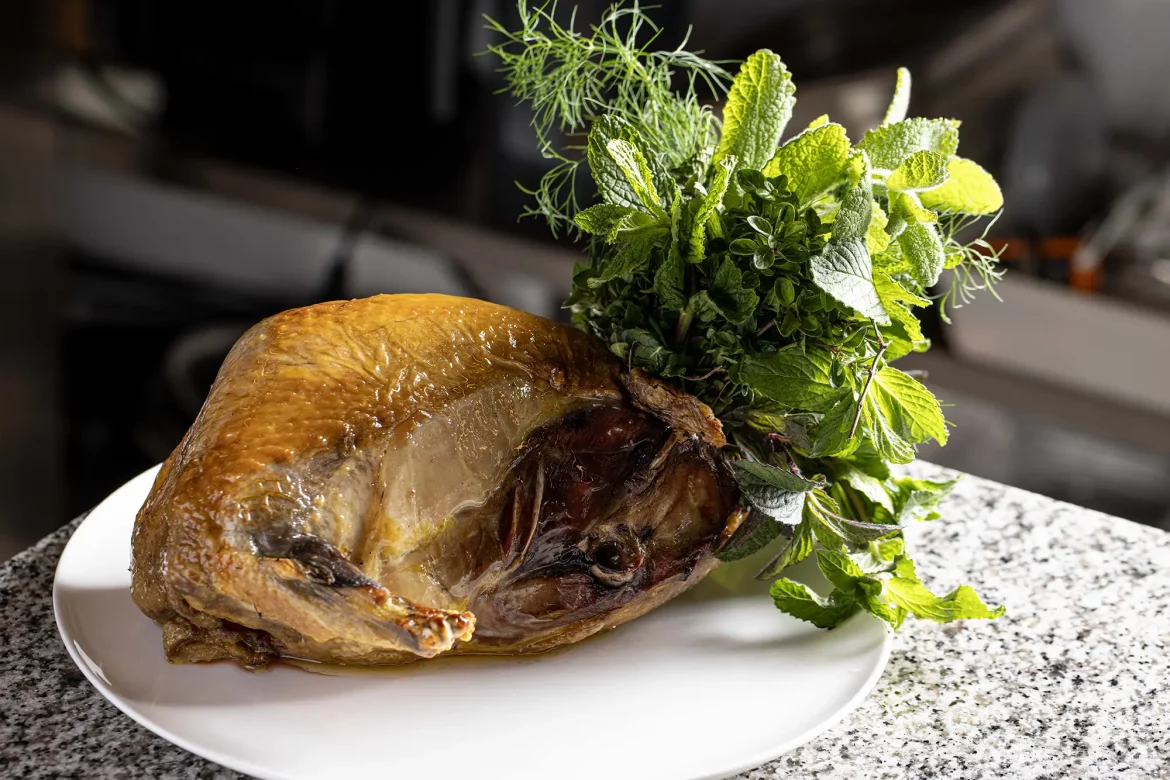
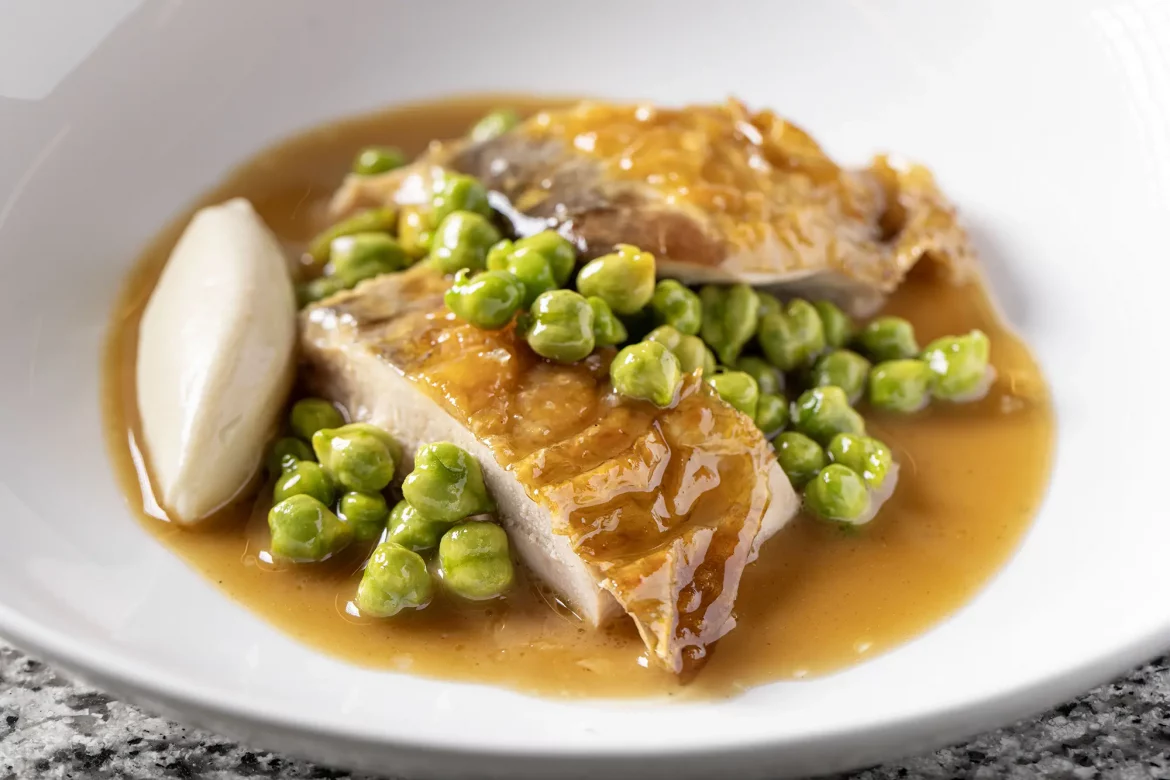
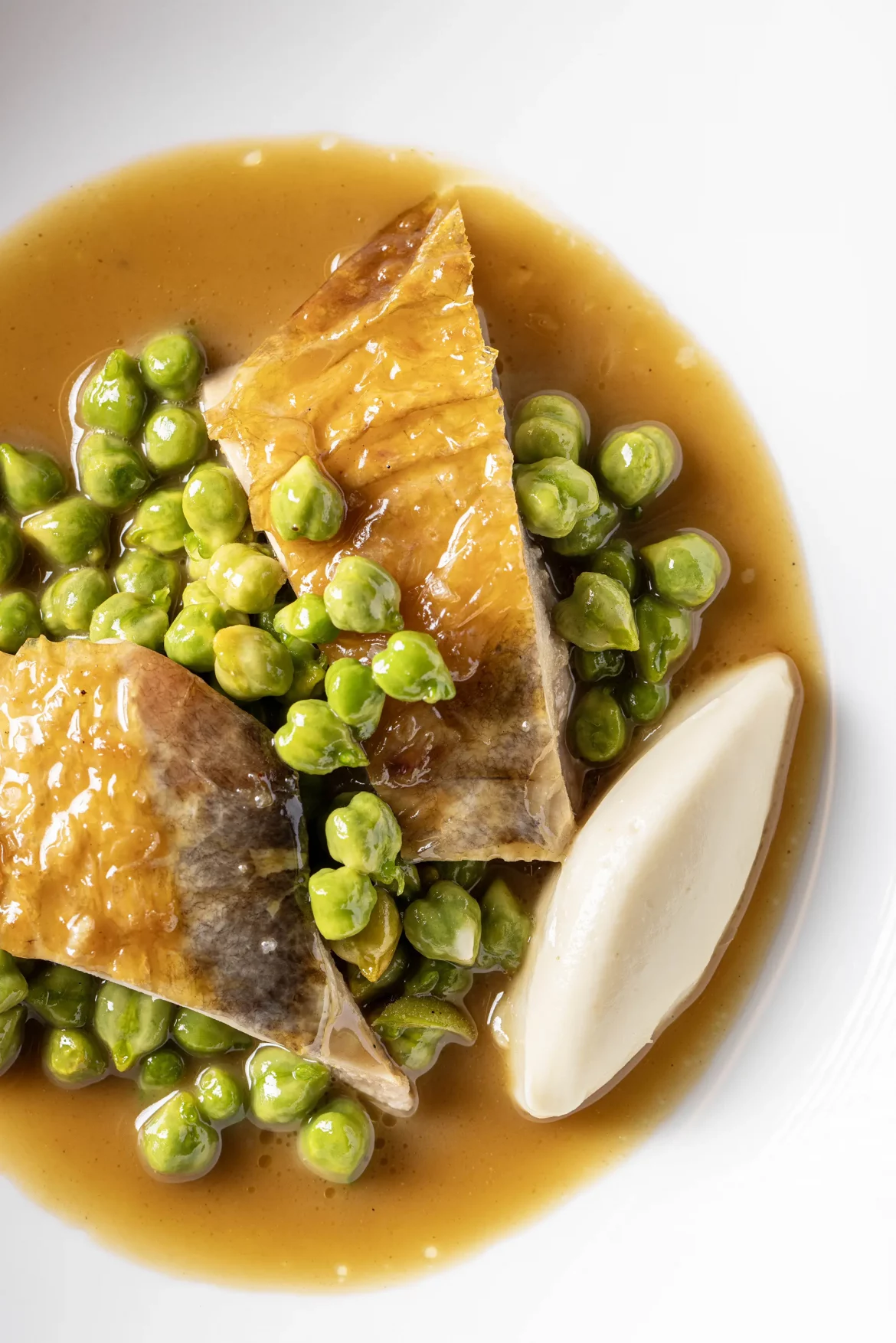
The Bresse guinea fowl is the moment everything converges. Two cuts with crisp, lacquered skin and blush-pink meat at a point that reveals hours of craft. Beneath it, an emulsified sole-bone fumet no one expects under poultry — its briny depth wraps the meat in a silky, almost marine unctuousness that a classic poultry jus could never reach. Patricia pairs it with a Fino La Ina by Pedro Domecq, pre-2008 label, already served one course earlier: the fino reappears as an ingredient in the stew and the palate recognises it. Palate pedagogy. This is the dish where you see what Coco can become: faultless cooking, a sauce with memory, a pairing that closes an arc begun three courses before. If there were eight dishes like this one, the conversation would be different.
Before dessert we could not resist Bernard Antony — France’s most legendary maître affineur, supplier to L’Arpège, Guy Savoy, Ducasse, Pic. That a Madrid restaurant with a single star has access to his cheeses speaks of something money cannot buy: the trust Passard placed in his disciple, extending like a living lineage to the purveyors they share. Antony does not open his caves to just anyone. He opens them to family. Ten pieces, all cave-aged in Alsace. 48-month Comté with casein crystals that crunch like salted caramel. A 30-month Gruyère transformed by Antony’s hand until it could be mistaken for Comté — the affineur does not preserve; he reinvents. And an arc that closes the menu: we opened with raw apple under Italian Parmigiano and close with cooked apple over French cave cheeses. That is written with premeditation, not inertia.
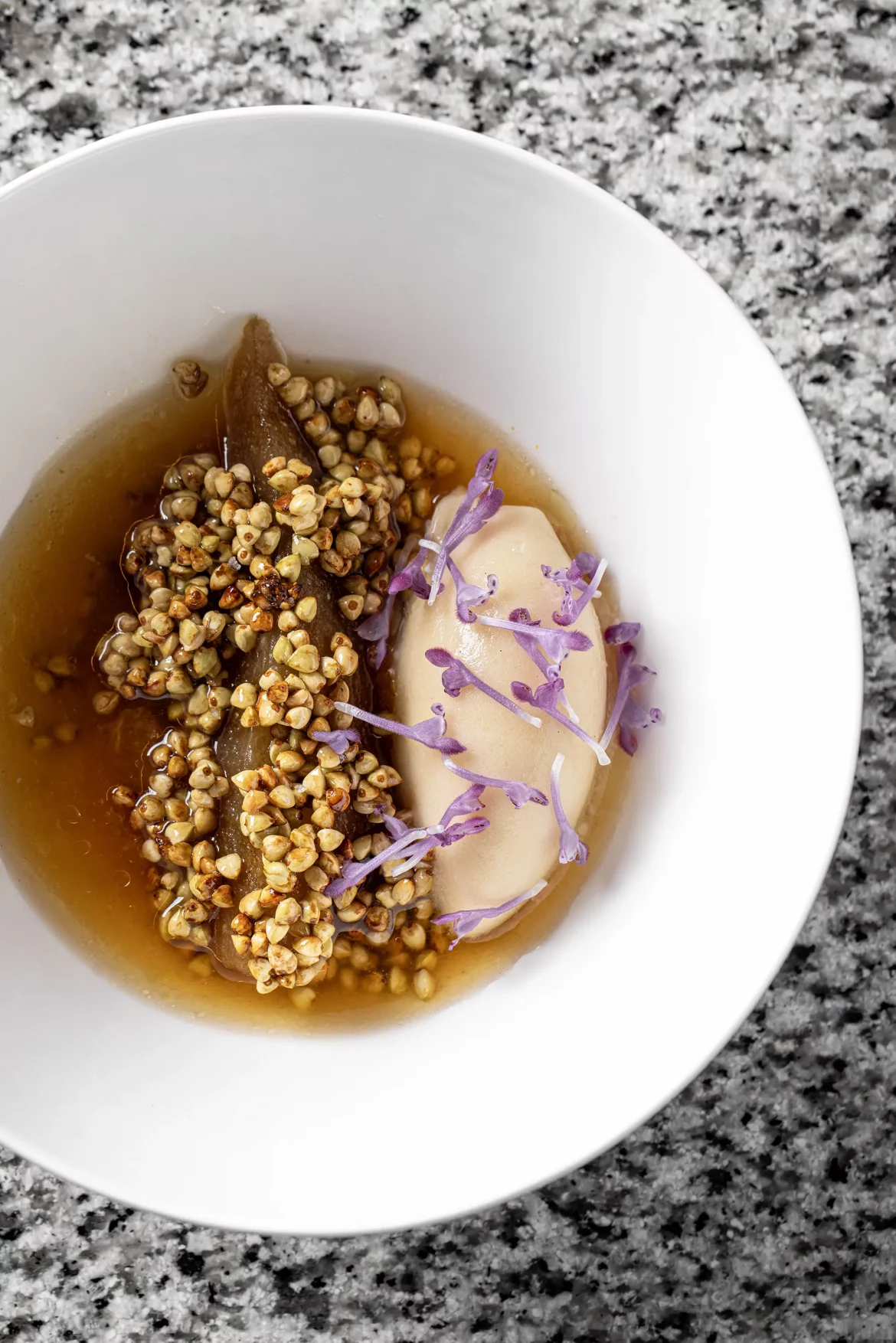
The desserts — 74% cacao with tonka bean and grilled pear, salted-caramel soufflé with pink pepper — are clean craft but do not take the risks the savoury courses take in every bite. This is where Pabú has the most room to grow.
Four hours at the table. Patricia García led the pairing with the certainty of someone who improvises because she knows exactly what she is doing — trained between Paris and Rome, a winemaker in Gredos with her own vines that she keeps off the Pabú list so as not to steal the spotlight from the chef. Rita González governed the room with the authority of someone who has grounded every one of her son’s ideas in reality. And Coco Montes cooked a menu that is not a sequence of dishes but a composition of mirrors, bridges and narrative breads.
The nods to Passard are still visible — invisible sauces, fumet under fowl, Antony’s cheeses, the radical primacy of vegetables. But they are reverent citations by someone who speaks the language fluently, not crutches of someone who has no other. When Coco takes off with ideas entirely his own — and he will, because this menu proves he thinks like a composer, not an interpreter — he will lack nothing.
Pabú does not shout. It builds. Three Michelin stars are not a delusion. They are the natural horizon of a chef who already thinks at that frequency. And watching him take off from this table is one of the privileges Spanish gastronomy offers today.

Pabú · Calle de Panamá, 4. Madrid · Chef: Coco Montes · Sommelier: Patricia García · Dining Room: Rita González · Pate Menu (8 courses) · Bubú Menu courses) · Real price with drinks:· 1 Michelin Star · 1 Sol Repsol · Tel. +34 911 048 605 · restaurantepabu.com