



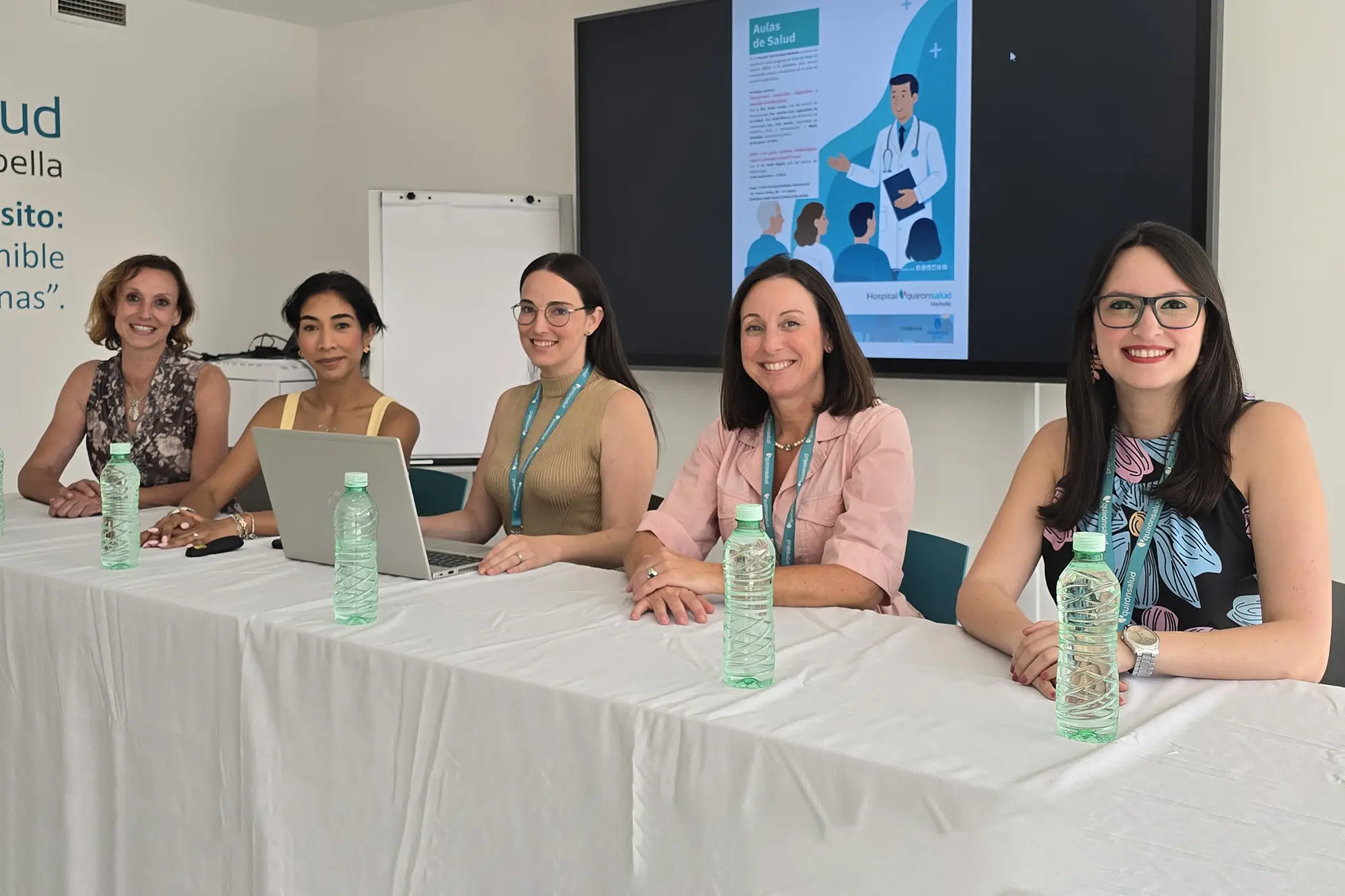
The hospital is launching its Health Workshops with a multidisciplinary approach focused on prevention, early diagnosis and comprehensive treatment of this ‘silent’ disease
Quirónsalud Marbella Hospital has launched its Health Seminars programme with a session dedicated to osteoporosis, a highly prevalent condition that progresses silently and can have serious consequences if not detected in time.
During the event, specialists from various fields agreed on a key message: osteoporosis does not cause pain until a fracture occurs. As explained, “osteoporosis is a disease that weakens the bones. The bones lose density and strength, and the risk of fractures increases, even with minor falls”. Furthermore, it was emphasised that “it is usually asymptomatic until a fracture occurs”, which underlines the importance of early diagnosis.
A silent disease that weakens the bones
Dr Cynthia León, a rheumatology specialist, discussed in her presentation what osteoporosis is and why it can go unnoticed for years. “Osteoporosis is a disease that weakens the bones,” she explained, adding that this condition leads to a progressive loss of bone density and strength, which significantly increases the risk of fractures, even following minor falls.
She also pointed out that signs such as a loss of height or back pain may appear, although in most cases the disease progresses without obvious symptoms until it reaches advanced stages.
Menopause and hormone therapy: acting at the right time
Dr Isabel María Blanco, Head of the Gynaecology Department, explained the impact of the menopause on bone health, noting that “the natural reduction in oestrogen accelerates bone resorption”, which leads to rapid bone mass loss. In this context, she emphasised the importance of an individualised approach and the timing of intervention, highlighting that “starting hormone therapy within the first 10 years after the menopause not only effectively prevents rapid bone mass loss, but is also associated with an excellent long-term cardiovascular safety profile”.
Diet: a key and modifiable factor
For her part, Merly Villamizar, a nutritionist, highlighted diet as one of the fundamental pillars of prevention. “Nutrition is one of the most important modifiable factors affecting bone health,” she stated, pointing out that osteoporosis is a multifactorial condition involving various factors, including diet. In this regard, she emphasised that “it is the diet as a whole that needs to be improved” in order to achieve an adequate nutritional balance that protects bone structure.
Therapeutic exercise: key to preventing fractures
Dr Pilar Román, a specialist in Physical Medicine and Rehabilitation, highlighted the role of exercise as one of the most effective tools in combating osteoporosis, noting that “muscles stimulate the bones to stay strong” and directly help to reduce the risk of falls.
During her presentation, she explained that not all exercises have the same effect, and that the most beneficial are, first and foremost, strength training, followed by high-impact exercises and those aimed at improving balance and stability. As examples, she cited working with weights, resistance bands or machines, as well as activities such as Pilates Reformer or dancing.
Exercise can be undertaken at any stage of osteoporosis, although Dr Román points out that “sometimes a specific assessment is required to tailor the programme to the individual”.
Treatment: preventing fractures to save lives
Dr Nerea Costas, Head of the Rheumatology Department, addressed the treatment of osteoporosis from a strategic, long-term perspective, tailored to each patient’s risk profile. “Osteoporosis is a long-distance race,” she explained, emphasising the need for a continuous approach, structured in different phases with the aim of strengthening the bones and maintaining the benefits over time.
She also emphasised the importance of proper treatment planning and adherence to treatment: “Your bone health depends on a well-organised, safe and informed treatment plan”.
The ultimate goal, shared by all specialists, is clear: to prevent fractures and their consequences, preserving not only bone health but also patients’ independence, quality of life and life plans.
A comprehensive approach based on prevention
The Health Classroom highlighted the importance of a multidisciplinary approach that combines early diagnosis, healthy habits and personalised treatment.
Through this initiative, Quirónsalud Marbella Hospital reinforces its commitment to health education, bringing medical knowledge to the public and encouraging a proactive approach to healthcare.
Quirónsalud in Andalusia
The Quirónsalud Group in Andalusia currently operates eight hospitals located in the cities of Málaga, Marbella, Los Barrios (Cádiz), three in Seville (Sagrado Corazón, Infanta Luisa and Materno-Infantil), Córdoba and Huelva, as well as two surgical day hospitals in Seville and Málaga and 22 specialist and diagnostic medical centres; this positions it as the leading private hospital provider in this autonomous community.
About Quirónsalud
Quirónsalud is the leading healthcare group in Spain and, together with its parent company Fresenius-Helios, also in Europe. In addition to its operations in Spain, Quirónsalud also has a presence in Latin America. Together, the group employs over 50,000 professionals across more than 180 healthcare centres, including 57 hospitals with over 8,000 beds. It utilises state-of-the-art technology and boasts a large team of highly specialised professionals of international renown. Its centres include the Jiménez Díaz University Hospital, Teknon Medical Centre, Ruber Internacional, Quirónsalud Madrid University Hospital, Quirónsalud Barcelona Hospital, Dexeus University Hospital, Policlínica Gipuzkoa, General University Hospital of Catalonia, Quirónsalud Sagrado Corazón Hospital, etc.
The Group is committed to promoting teaching (eleven of its hospitals are university hospitals) and medical and scientific research (it operates the FJD Institute of Health Research, accredited by the Ministry of Science and Innovation).
Furthermore, its healthcare service is organised into cross-disciplinary units and networks that enable it to make the most of the experience accumulated across its various centres and to facilitate the clinical application of its research. Quirónsalud is currently carrying out a wide range of research projects throughout Spain, and many of its centres are at the forefront of this field, pioneering work in various specialities such as oncology, cardiology, endocrinology, gynaecology and neurology, amongst others.