



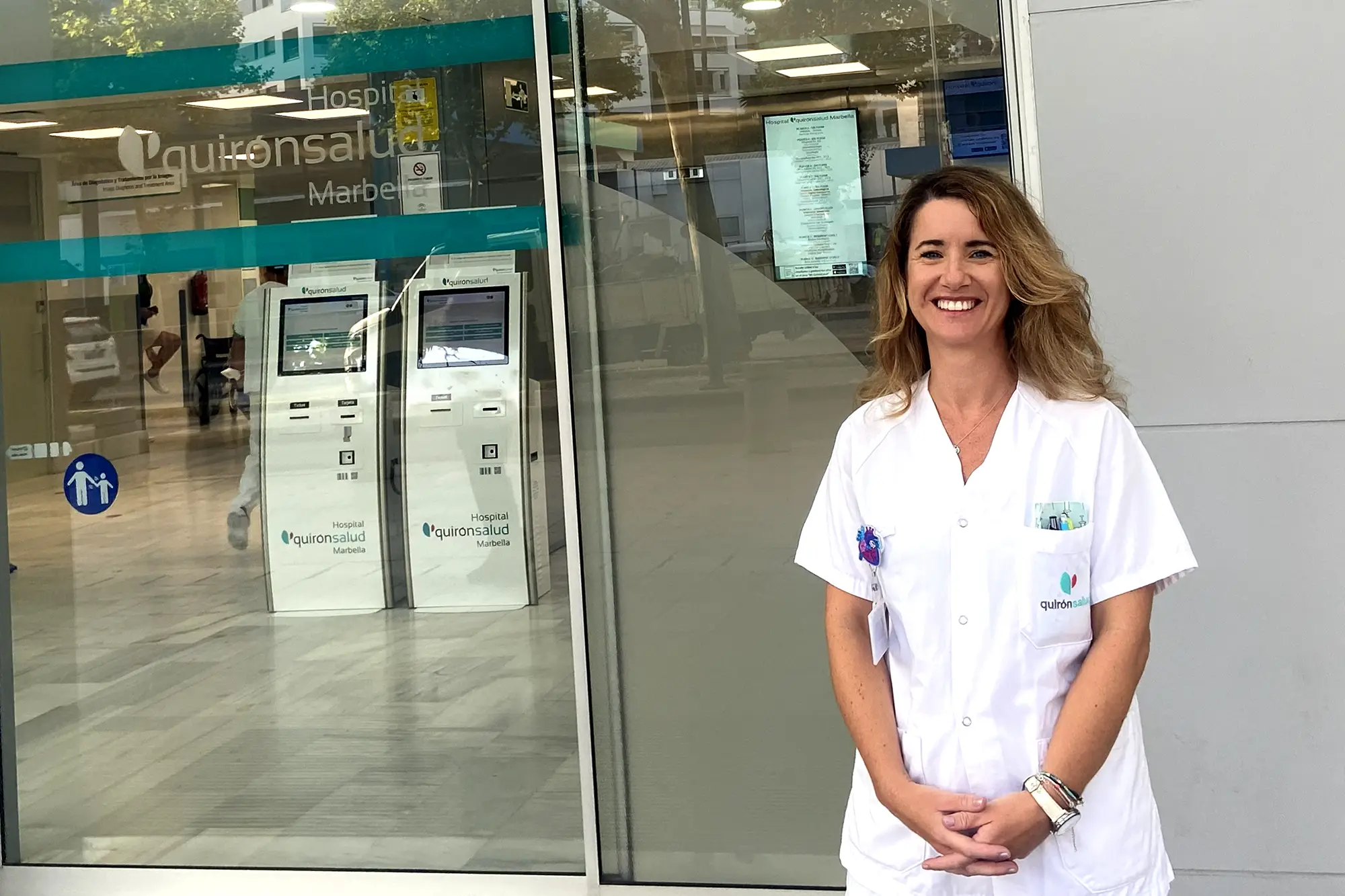
- Continuing your day at the beach despite an injury can complicate its treatment, warns the head of the Emergency Department at Quirónsalud Marbella Hospital
- Jellyfish, mosquitoes, and weever fish are among the most frequent stings during the summer
During the summer, consultations related to beach and marine activities increase in the Emergency Department. Superficial wounds, cuts, abrasions, minor bruises, stings, sunburn, dehydration, dizziness, and heat-related problems are among the usual cases seen during these months.
However, many of these initially minor injuries can become complicated if they are not treated correctly or if medical evaluation is unnecessarily delayed. For Dr. Esther Hurtado, head of the Emergency Department at Quirónsalud Marbella Hospital, one of the main problems is precisely downplaying the severity of the injury.
“One of the most frequent mistakes is thinking that a small wound doesn’t need any care. It’s one thing for it not to require a trip to the Emergency Room, and another for us to ignore it. The best course of action is to clean it properly, remove any visible dirt, control any bleeding, and keep it protected,” she explains.
Waiting until the end of the beach day
Among the situations that can complicate an injury is delaying seeking medical attention to continue enjoying the day. “We also see patients who deliberately delay seeking medical help because they want to make the most of their day at the beach,” the specialist points out.
In these cases, the wound may occur in the morning and remain covered while the person continues swimming or carrying out their usual activities until they go to the Emergency Room in the afternoon or even at night.
“They get a wound in the morning, cover it up as best they can, continue swimming or doing their usual activities, and wait until the afternoon or even at night to go to the Emergency Room,” explains Dr. Hurtado. This delay can be especially significant when dealing with wounds that require stitches. “Some wounds have a limited window of time for optimal primary suturing,” she warns. Furthermore, “the longer the time that passes, the greater the risk of wound contamination, and depending on the type, location, and mechanism of injury, the risk of infection may increase, or it may become necessary to consider another type of closure.”
For this reason, the specialist points out that “for a wound that is deep, wide open, has separated edges, continues to bleed after adequate pressure, or was caused by a potentially contaminated object, I wouldn’t advise waiting until the end of the day at the beach to seek medical advice.”
Home remedies, another common mistake
Bites and stings are another common reason for consultation during the summer, especially those caused by jellyfish and mosquitoes. In these cases, another mistake is resorting to home remedies without knowing if they are appropriate.
“Another fairly common error is trying to treat certain injuries with home remedies,” the doctor explains. In the case of jellyfish stings, “rubbing the area with sand or directly handling the animal’s remains can worsen the injury.”
The specialist recommends that, in the event of a jellyfish sting, the area should not be rubbed or home remedies applied. “The best course of action is to clean the injury with seawater and go to the lifeguard station for an initial assessment.”
Weever fish stings are also common during the summer. This animal is usually found on sandy bottoms and can be partially buried, so it is possible to accidentally step on it when entering or walking in shallow areas. Its venomous spines can cause a small wound accompanied by very intense pain.
“In the event of a sting, the first thing to do is get out of the water and go to the lifeguard station or request assistance, especially if the pain is significant,” Hurtado points out. As an initial measure, he adds, “immerse the affected area in hot water, since the weever fish toxin is heat-sensitive. So, submerge the injury for approximately 30-90 minutes in hot water,” provided there is no pre-existing burn and monitoring the temperature to avoid causing further injury.
Don’t underestimate the symptoms caused by the heat
Dr. Hurtado reminds us that heat is another summer risk that shouldn’t be minimized. “Dizziness, weakness, headache, nausea, or vomiting after spending many hours in the sun shouldn’t be interpreted simply as ‘the heat has upset our stomachs’.”
The appearance of certain symptoms should prompt a search for urgent medical attention. “If confusion, altered behavior, loss of consciousness, or progressive worsening occurs, we are facing a situation that requires urgent medical attention,” she warns.
Water accidents require special caution
Along with minor injuries, summer also sees accidents related to swimming and water sports. In Marbella, where there is high activity on the beaches and in the marina during the summer months, activities such as paddle surfing, kayaking, windsurfing, kitesurfing, jet skiing, and recreational boating are popular.
Injuries can include bruises, cuts, sprains, and dislocations, although higher-impact accidents and those that occur in the water can have more serious consequences. Impacts against the seabed require special attention, especially when jumping or diving without knowing the depth. “A seemingly simple accident in the water can turn into a significant head or spinal injury,” explains the head of the Emergency Department.
Therefore, the recommendation is clear: “Do not dive headfirst into the water if you are not fully aware of the depth and conditions of the location.”
Drowning prevention is also a priority in aquatic activities. “In water sports, therefore, we must not only think about traumatic injuries: preventing drowning is a priority,” Hurtado emphasizes.
In this context, the specialist reminds us that accidents can result from a combination of different factors, including “a misjudgment of sea conditions due to fatigue, lack of experience, heat, alcohol consumption, etc.”
Most injuries that occur on the beach are minor, but the initial response and the timing of seeking medical evaluation can be crucial. As Dr. Hurtado summarizes, “The most frequent mistake is minimizing the problem and waiting too long.” Quirónsalud in Andalusia
The Quirónsalud Group in Andalusia currently has eight hospitals located in the cities of Málaga, Marbella, Los Barrios (Cádiz), three in Seville (Sagrado Corazón, Infanta Luisa, and Materno-Infantil), Córdoba, and Huelva, as well as two surgical day hospitals in Seville and Málaga and 22 specialty and diagnostic medical centers; making it the leading private hospital group in this autonomous community.
About Quirónsalud
Quirónsalud is the leading healthcare group in Spain and, together with its parent company Fresenius-Helios, also in Europe. In addition to its operations in Spain, Quirónsalud also has a presence in Latin America. It employs more than 55,000 professionals in over 180 healthcare centers, including 57 hospitals with more than 8,000 beds. It boasts state-of-the-art technology and a large team of highly specialized and internationally renowned professionals. Among its centers are the Jiménez Díaz Foundation University Hospital, Teknon Medical Center, Ruber Internacional, Quirónsalud Pozuelo University Hospital, Quirónsalud Barcelona Hospital, Dexeus University Hospital, Gipuzkoa Polyclinic, General de Catalunya University Hospital, Quirónsalud Sagrado Corazón Hospital, and others.
The Group is committed to promoting teaching (fourteen of its hospitals are university hospitals) and medical-scientific research (it has the Jiménez Díaz Foundation Health Research Institute, accredited by the Ministry of Science and Innovation).
Furthermore, its healthcare services are organized into cross-functional units and networks that optimize the accumulated experience across the different centers and facilitate the clinical translation of its research. Currently, Quirónsalud is developing numerous research projects throughout Spain, and many of its centers are at the forefront of this field, pioneering work in various specialties such as oncology, cardiology, endocrinology, gynecology, and neurology, among others.